
One could argue that Guillermo Del Toro’s career has been leading straight to his Frankenstein. Del Toro is, in many ways, a mechanist of monsters—figures like the titular Pan, the Amphibian Man, Hellboy, or even the Kaiju. But the true monsters, as Del Toro—and Shelley—knew, aren’t the creatures themselves. Frankenstein is the monster: the soldiers in Pan’s Labyrinth, the evil scientist in The Shape of Water, Stan Carlisle in Nightmare Alley. Even the Precursors, who unleash chaos on the Kaiju in Pacific Rim, reveal the same truth: humans are often the monsters. In our modern world, one could argue, the monsters have won—and perhaps that’s why, now more than ever, Del Toro wanted to dissect this myth with the same care that Frankenstein gives his corpses.
Del Toro’s Frankenstein begins faithfully to the book, with the Arctic as the centerpiece and Robert Walton’s crew frozen in place. There they meet the broken Victor, who begins his tale of how he created the cursed creature. The story takes us back first to his childhood—full of medicine and misery, both imposed by his father—and then to his mythmaking: a man with a dream that to his critics seems straight from Satan himself, though to him given by an angel, to control life. In Del Toro’s version, we are introduced earlier to Victor’s brother William, and William’s bride, Elizabeth. She is besotted on by Victor, seemingly over a shared fascination with creatures. Victor’s hubris, however, gets the better of him: even as he succeeds in creating life, he so clearly fails in his own and with others. This is, of course, the true story and moral of Del Toro’s Frankenstein, so clearly modeled after the full title of Shelley’s book, Frankenstein; or, The Modern Prometheus, as we are reminded repeatedly by characters who directly compare Victor to this tragic figure.
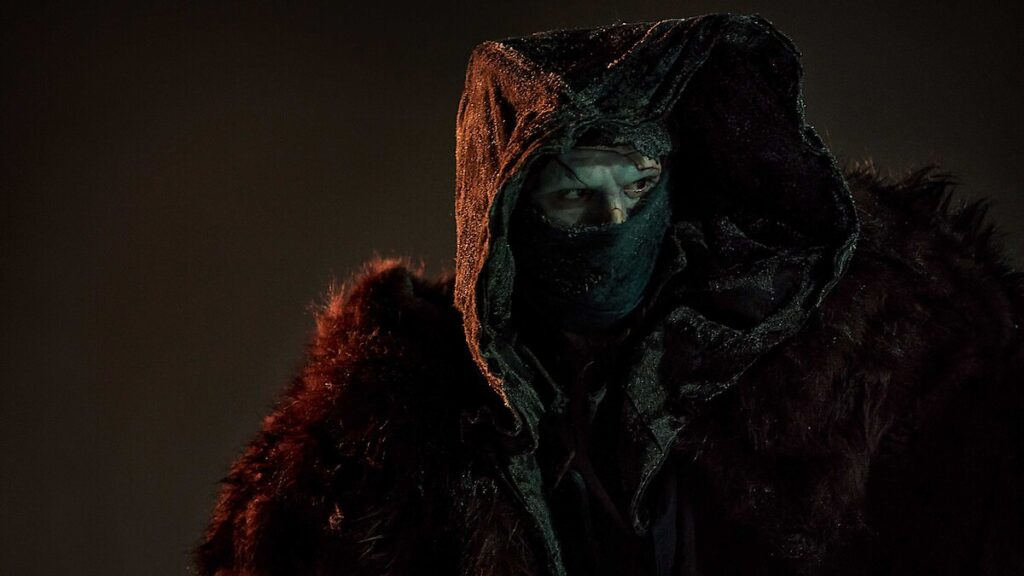
Jacob Elordi in Frankenstein (Ken Woroner/Netflix)
Though Guillermo Del Toro is known for his horror and visual aesthetic, his gothic roots have always made his films more approachable for someone like myself, who often reels from modern horror movies. I found Crimson Peak incredibly beautiful, even if the story was somewhat shallow. Pan’s Labyrinth was haunting—not just because of Pan’s domain, but as a parable. This is to say I expected Del Toro’s Frankenstein to be horrific in its own ways, but perhaps not with slasher dread, jump scares, and gruesome deaths. Yet, this is Del Toro—so stylistically, he toes the line as close as he dares. The first third of the film, in particular, is bleak, with cadavers, undead corpse parts, and the occasional jump scare, strewn both literally and metaphorically throughout. Victor has one cadaver he’s working on, arranged like a turkey at dinner—a detail perhaps unsurprising for the character, but still off-putting for the audience. Of course, we’re not supposed to like Victor, and if that wasn’t clear before, it becomes unmistakable here.
In many ways, this early period—after Victor’s childhood, a surprisingly rich portrayal that clearly sets the tone for all of his actions—is the hardest to take, though perhaps that’s due to the inevitability of Victor’s cursed path. We see him as the young villain set on his destiny. Thankfully, Victor is joined by other presences, including Christoph Waltz, always a welcome treat, who makes a delightful addition as Victor’s benefactor, with his own reasons for supporting him. During this time, we also see Victor’s brother William in part, and more prominently, Mia Goth’s Elizabeth. Goth’s portrayal is perhaps a bit familiar for Del Toro, as he has a history of crafting characters that inspire fan fiction, and Elizabeth is no exception. She shows fascination with creatures, even going so far as to trap one, yet unlike Victor, she remains sympathetic. Goth’s performance is more than serviceable; however, there are leaps in Elizabeth’s actions that don’t always match her earlier characterization, leaving me more perplexed than amused.
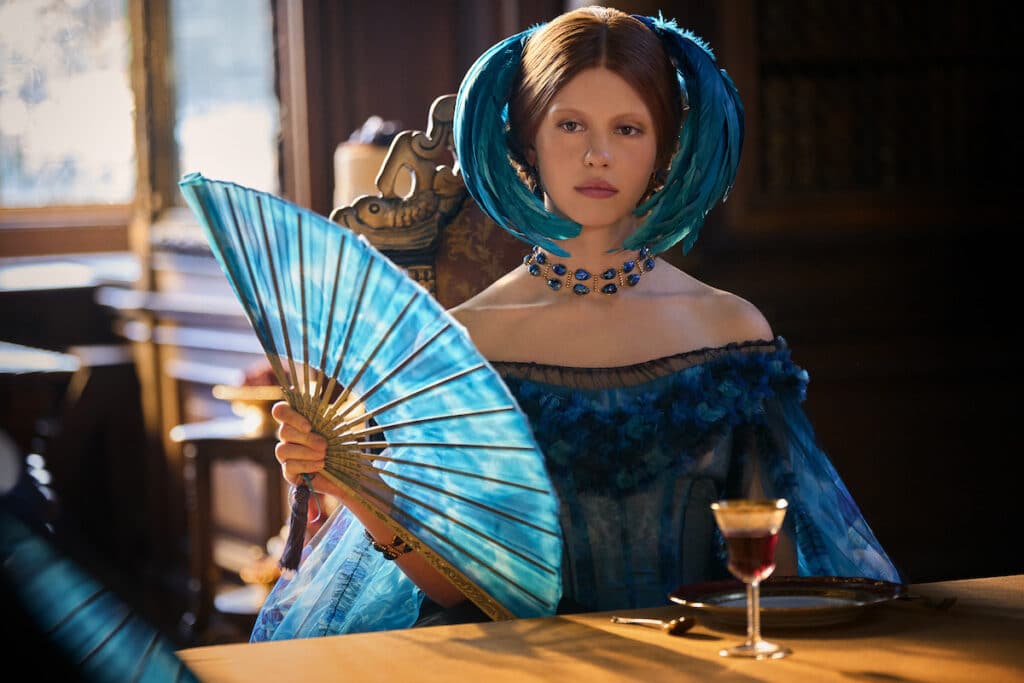
Mia Goth in Frankenstein (Ken Woroner/Netflix)
Of course, I’ve gone this far without much mention of the monster, and yet much needs to be said about Jacob Elordi’s creature. As expected, especially given Elordi’s towering 6’5” frame, he’s a presence to behold. Early in his creation period, he seems far removed from the flesh of the man said to have made him, appearing more golem than ghoul. Del Toro, having recently eschewed AI, seems a believer in practical effects; however, I’m unclear how much of Elordi’s portrayal is makeup and costume versus digital effects. As we see more of the creature over time, we witness a shift toward an almost emo portrayal—long hair cascading over his shoulders, close-ups of Elordi’s expressive eyes bringing us into the creature’s inner world. Though it’s far from the nuts-and-bolts portrayal of the Universal Frankenstein, it works, especially alongside some of Del Toro’s alterations to the creature’s physiognomy.
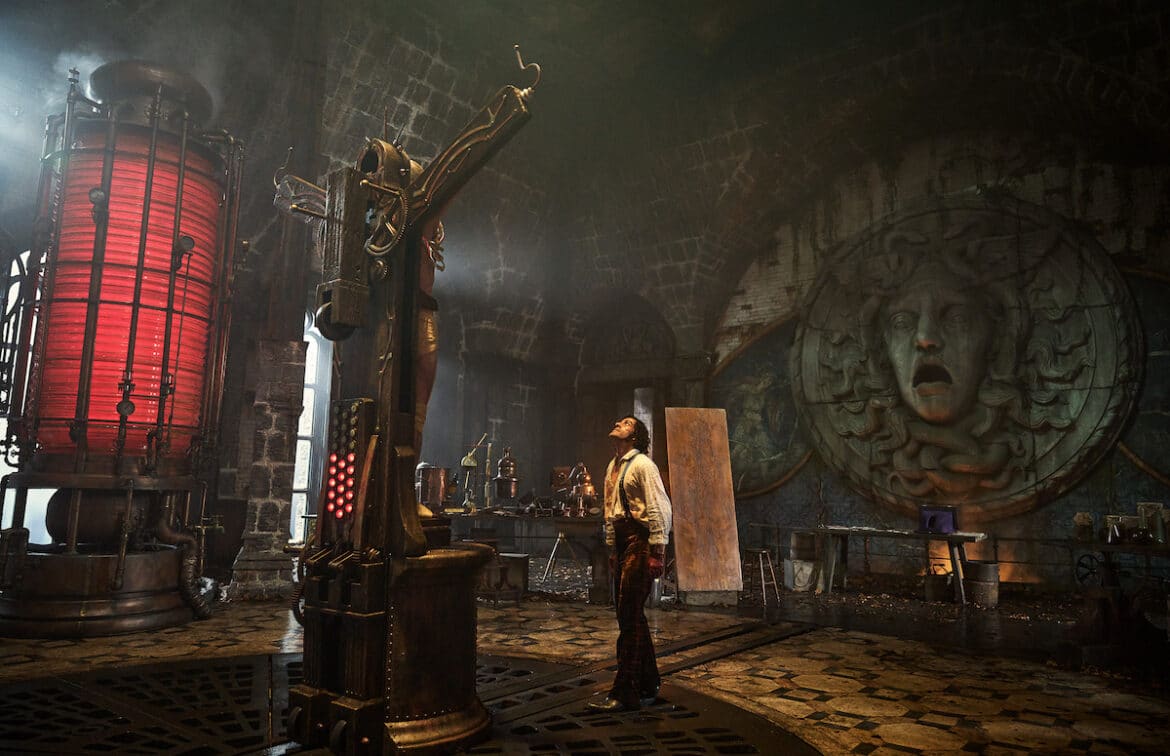
Much like the visuals of Frankenstein, much of the film is stirring. The castle is a unique figure—striking high into the sky, perhaps a metaphorical reach toward God. Yet some scenes—particularly the action sequences—lean more heavily on CGI than practical effects, and a few dramatic moments struck me as unintentionally funny. I wondered if this would be noticeable to viewers seeing the film on Netflix instead of on the big screen. Thankfully, these moments are brief, and seeing the film in theaters allowed me to appreciate the more marvelous visuals.
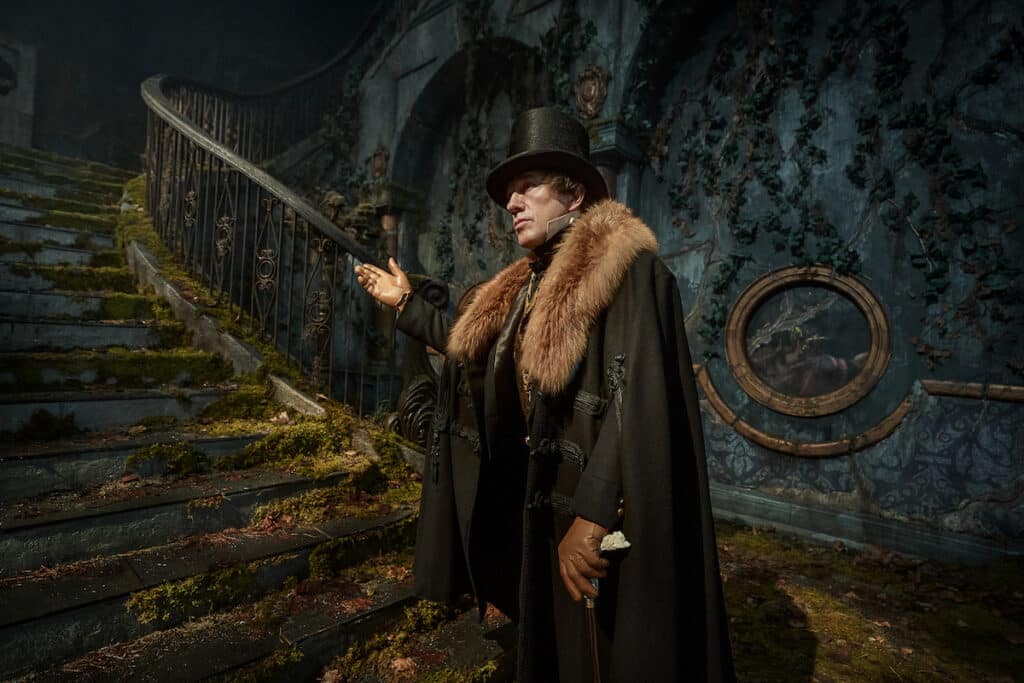
Christoph Waltz in Frankenstein (Ken Woroner/Netflix)
A day after viewing, I’m still processing the pieces of this film. Like Frankenstein’s creature, the parts, when brought together, are strong; however, there are weaknesses that stand out on closer inspection. I mentioned Elizabeth’s confounding motivations. There are also inconsistencies in smaller scenes—for instance, the wolves—and even certain key lines delivered by the creature contradict his later actions, making the moment more befuddling than impactful. One particular change to the creature’s makeup feels drastic compared to the book, and perhaps unnecessary, as the story ultimately arrives at the same narrative point. Moments and decisions like these continue to nag at me.
Thankfully, what’s perhaps most successful is the metaphor and message. Victor’s hubris and drive—his belief that it is God-given—is a story for the ages, and particularly resonant today. We live in a world where monsters may indeed be at the helm, and though they aren’t creatures, their impact on humanity is no less dangerous. Del Toro’s fascination with monsters, death, and power is not born of isolation, but of a world steeped in these themes. This mirrors Mary Shelley, who, despite her youth, delivered a masterpiece for her time. While it remains uncertain whether there will ever be a “definitive” Frankenstein for our era—especially with multiple adaptations emerging simultaneously—Del Toro’s vision, execution, and craftsmanship may make this film stand out, not just for our time, but for generations to come.
All photos © Netflix. Featured image: Ken Woroner/Netflix.