
If you asked the average American about the legacy of President James Garfield, a few might answer, “Wasn’t he the one who was shot?” while others may respond, “Wait… the cat?” Without pop-culture depictions of our lesser-known presidents—and given the sorry state of civic education—it’s no surprise most people know little about the majority of them. I’m a great fan of studying American history, yet I’ll admit I knew embarrassingly little about Garfield going in, aside from his fate.
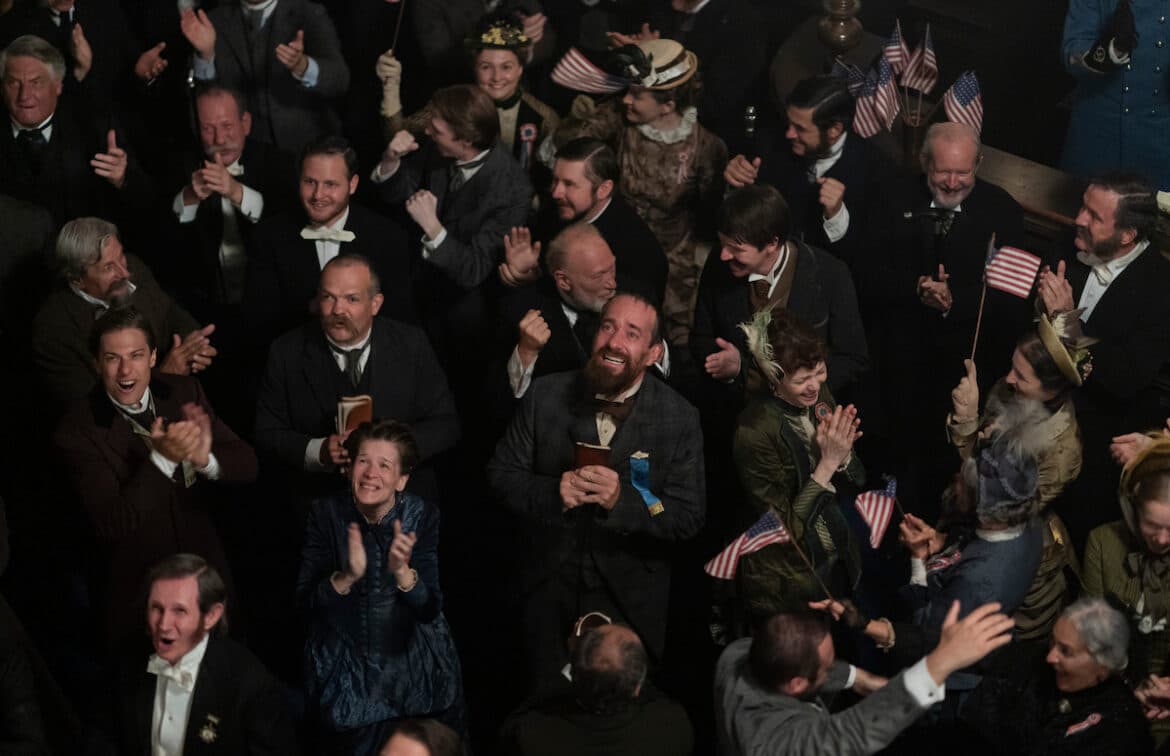
Netflix’s Death by Lightning, created by Mike Makowsky and based on Candice Millard’s 2011 book Destiny of the Republic, seems to understand this. The series even opens by framing itself as the story of two forgotten men. That’s perhaps why smartly rather than relying on exposition dumps, which would bore an audience, it draws viewers smoothly into the post-Lincoln 1880s: an era when the Republican Party dominated government through entrenched patronage and the last lingering era of “waving the bloody shirt.” The show smartly mirrors the politics then with politics now—perhaps coincidentally, though one suspects the writers leaned into the parallels. Afterall the same party remains in power today, yet a modern Republican would hardly recognize its ancestor—least of all the version embodied by Garfield, played with remarkable nuance by Michael Shannon. His Garfield is written as the best the era had to offer, and when he delivers a spontaneous convention-floor speech so compelling it sways the entire room, the audience immediately understands why he outshines the friend his speech is purpotedly about. (Think Obama’s 2004 DNC speech.)
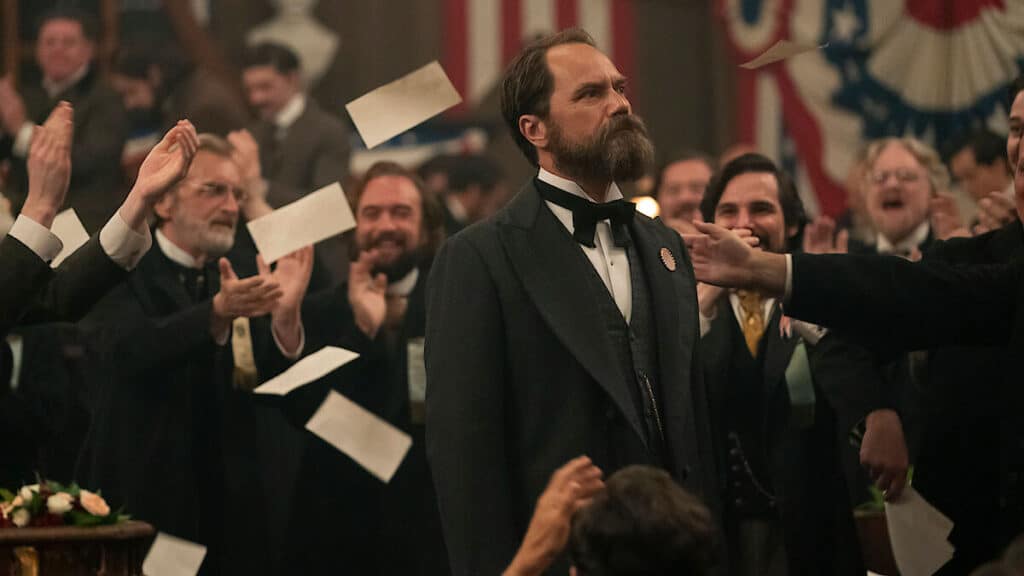
Michael Shannon as James Garfield in Netflix’s Death by Lightning (Credit: Larry Horricks/Netflix)
Garfield insists vociferously that he does not seek higher office—a promise he repeats early on to his wife—but following the speech, his principles inevitably mark him as a champion of the people. He’s eloquent, anti-corruption, firmly opposed to the spoils system, and strongly pro–civil rights. The show’s portrayal of him is idealized, but even when it touches on his flaws—such as a disagreement with his daughter over immigration—they read as pragmatic rather than prejudiced. It’s perhaps the show’s clearest contrast with the modern political landscape.
Opposite Garfield stands the profoundly troubling Charles J. Guiteau, played with unnerving brilliance by Matthew Macfadyen. Early on, Macfadyen lets flashes of charm break through Guiteau’s grifter exterior, though they don’t linger for long. Guiteau is such a bizarre figure that, were he fictional, he’d feel implausible. Shunned twice by a free-love religious sect and doted on only by a sister too innocent to see him for the huxster he is, he weasels his way into the orbit of countless politicians. He claims credit for their victories, demands a job for imagined service, and when those “promises” inevitably go unfulfilled, he spirals from deluded opportunist into a mentally unstable man barreling toward his infamous act.
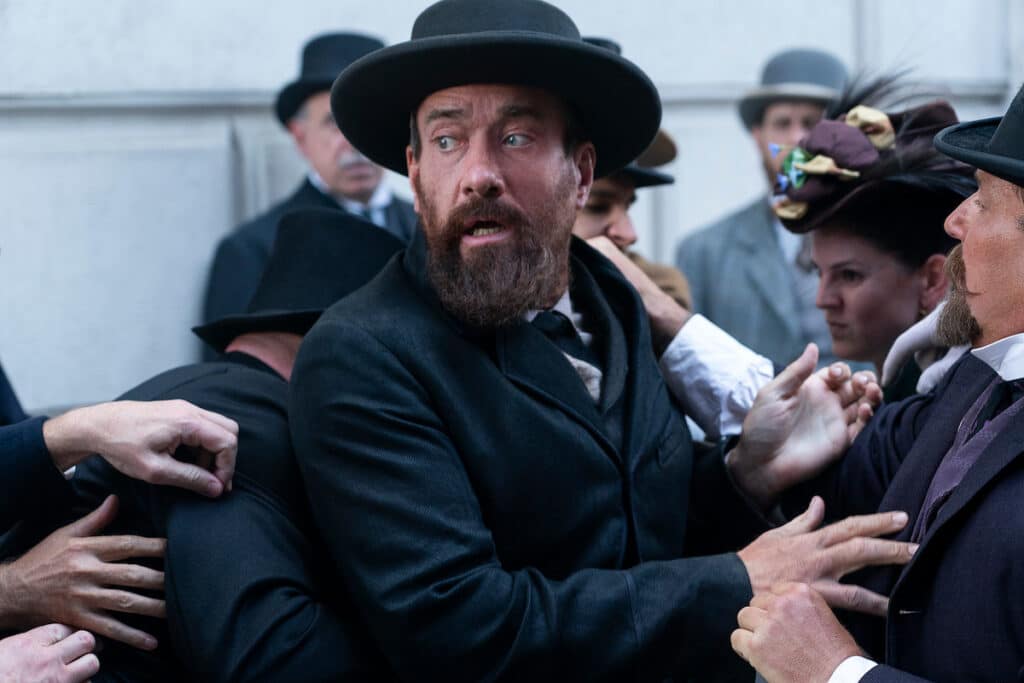
Matthew Macfadyen as Charles Guiteau in Netflix’s Death by Lightning (Credit: Larry Horricks/Netflix)
Though Shannon and Macfadyen expertly lead the show, the supporting cast is equally strong, with Bradley Whitford as James Blaine and Nick Offerman as Vice President (and future President) Chester A. Arthur among the standouts. Because most Americans aren’t especially familiar with this era, the costumes and production design help anchor the world. Still, the show makes little effort to replicate period speech patterns; characters often sound distinctly modern. While the major speeches draw from historical texts, Whitford and Offerman frequently deliver lines in a contemporary cadence that’s jarring at first but eventually becomes an amusing stylistic choice—likely intentional.
Certainly I mustn’t forget Betty Gilpin, as First Lady Lucretia Garfield, who disappears most completely into her role. Her performance feels authentically rooted in the language and manner of the period, and she shines in portraying a woman who, through devastating loss, would eventually help lay the groundwork for the presidential library system. (The series doesn’t mention this in the end credits, which feels like a missed opportunity.) Her storyline is given more space than I expected, considering the era, and Gilpin delivers some of the show’s most powerful emotional moments.
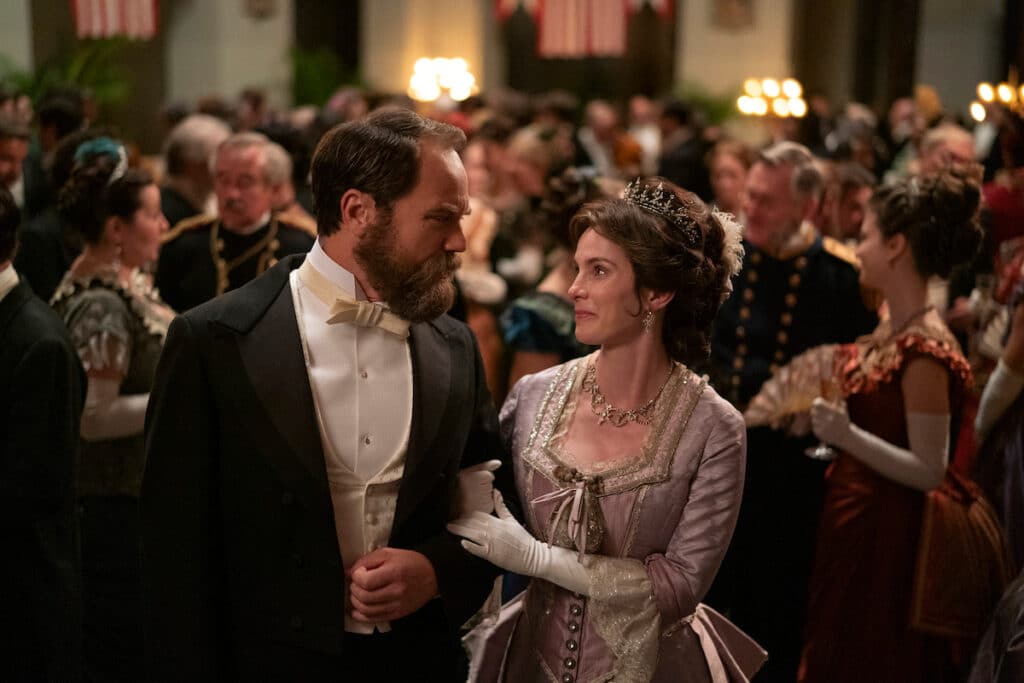
Michael Shannon as James Garfield and Betty Gilpin as Crete Garfield in Netflix’s Death by Lightning (Credit: Larry Horricks/Netflix)
Ultimately, Death by Lightning is a tragic tale, and what lingers is how—even if Garfield’s portrayal leans toward idealism—the series presents a vision of politics at its best. This isn’t The West Wing (despite Whitford’s presence), where both parties share a noble baseline of values, but it is a story suggesting that corruption can be confronted, even from within the party mired deepest in it. It’s a hopeful sentiment, one worth revisiting. Yet in today’s political climate, that optimism feels bittersweet. We’re reminded not only of Garfield’s unrealized dreams, but of our own—a nation seemingly too cynical, apathetic, or disengaged to prevent the same cycles of chaos and corruption from repeating.