
I was nearly nine when Spielberg’s adaptation of Crichton’s Jurassic Park hit the big screen, and despite my scaredy-cat tendencies, my dad took me to see the movie in theaters, whereupon he failed to warn me of nearly every scary part. Despite some inherent trauma from that screening, just a year or two later I remember watching with rapt attention as the film played on VHS at a friend’s birthday party, a half-dozen boys staring at the screen. I was hooked.
And yet, my love for the franchise dropped off over the years. I’ve never seen The Lost World: Jurassic Park because my dad thought it was awful, and though I saw the third film, Jurassic Park III, in theaters—and liked it better than most—I had no anticipation for a grand return of the franchise. That’s why I was so tentative to dip my toes into the newer live-action films. I only saw the first Jurassic World a couple of years after its release, and it wasn’t until the last two years that I finally watched Jurassic World: Fallen Kingdom (I’ve still yet to see Jurassic World: Dominion and the most recent film, Jurassic World: Rebirth).
So when I came upon Camp Cretaceous on Netflix—an animated kids’ series that, on its face, looked like a nostalgia-cash grab—I wasn’t sure what to expect. Still, I tentatively clicked play, and I’m so thankful I did.
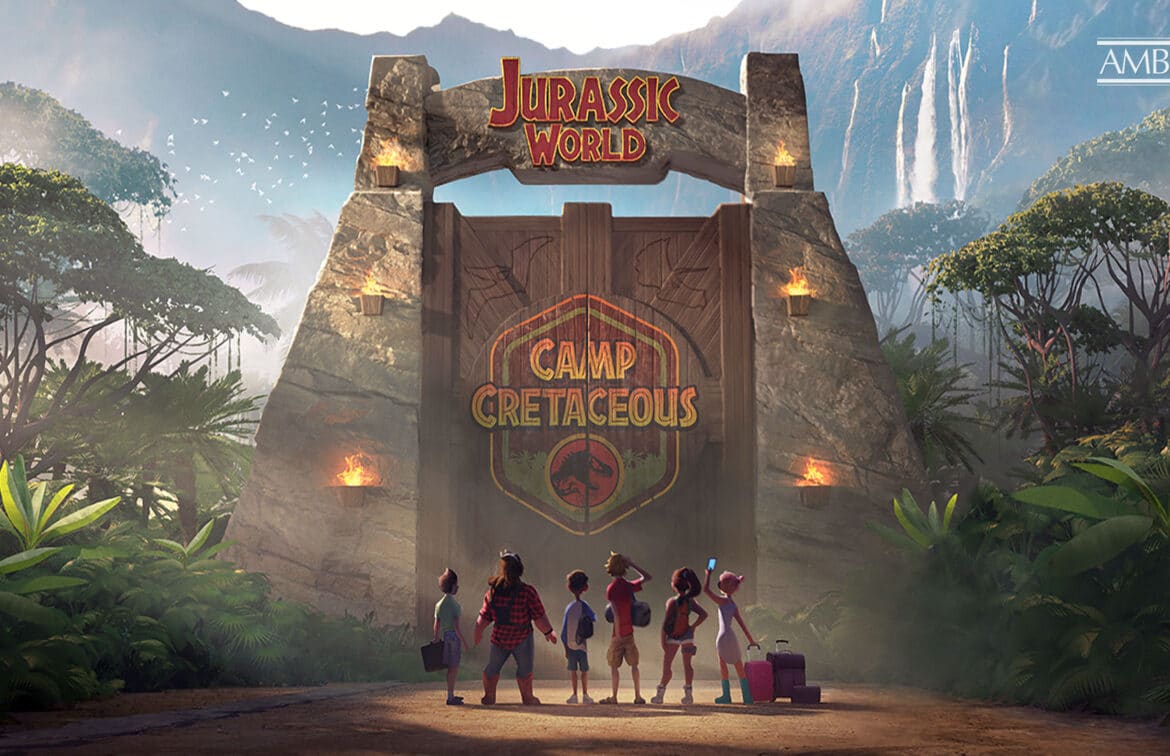
Jurassic World: Camp Cretaceous – (Photo Credit: DreamWorks Animation / Amblin Entertainment / NETFLIX © 2025)
To catch you up, if you’re unfamiliar with the Jurassic World franchise: in Jurassic World, now 22 years after the events of the original Jurassic Park, humanity has failed to learn its lesson. Once again, there’s a new dinosaur park on the original island, Isla Nublar, where the Masrani Global Corporation offers patrons a dino-adventure experience. Where the original felt more like the San Diego Wild Animal Park, the new iteration is more Disney World/Universal style. Not content with mere dinosaurs that actually existed, the company genetically engineers new creatures, including the particularly fearsome Indominus rex. As one would expect, everything goes haywire, and the first film ends with the death of many, the destruction of the park, and the abandonment of the island. (Much of this is reprised in Camp Cretaceous’s opening episode—which, let me remind you, is a kids’ show.)
Camp Cretaceous, which takes place during and immediately after the events of Jurassic World, follows a group of kids attending a camp on Isla Nublar who find themselves left behind with the dinosaurs after the park’s disaster. Left to fend for themselves, they must use their unique skills to come together, survive, and hopefully escape the island.
Without spoiling the finer details, Jurassic World: Chaos Theory jumps ahead six years, into the era of Jurassic World: Dominion. By now, dinosaurs have escaped into the human world, and while it’s not quite post-apocalyptic, their presence causes chaos on a global scale. The kids—now known worldwide as the “Nublar Six”—have largely grown apart, separated by distance and fractured communication, especially after the tragic death of one of their members. (Again—a kids’ show?!) That changes when one of them begins to suspect foul play in their friend’s death, pulling the group back together in search of answers.
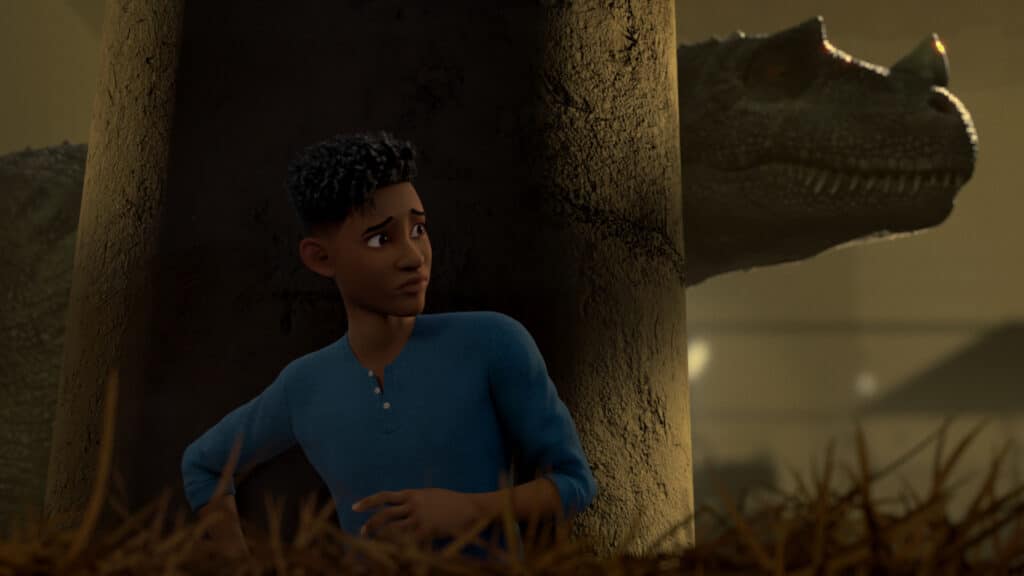
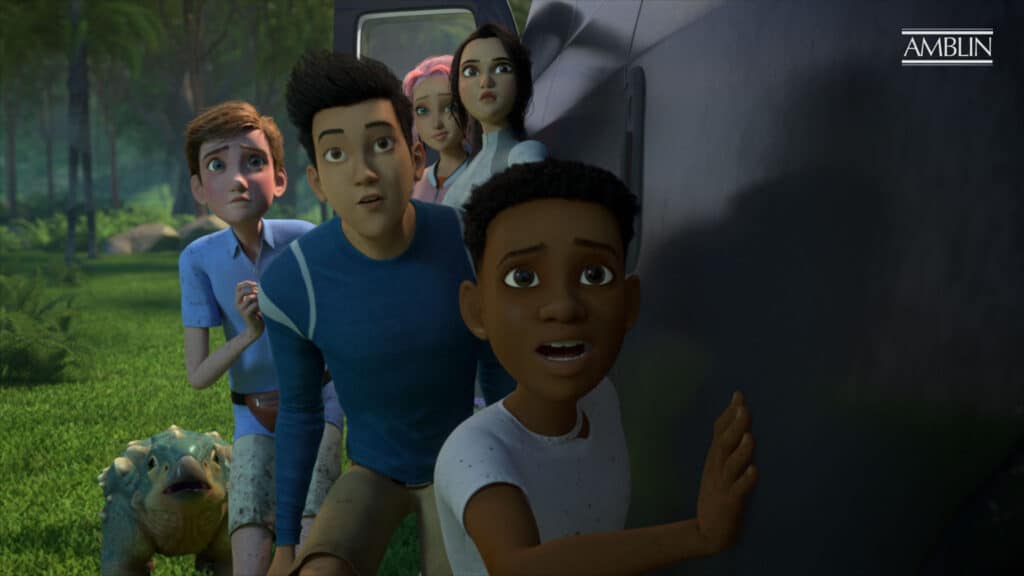
Jurassic World: Chaos Theory: Season 3. Paul-Mikél Williams as Darius Bowman in Jurassic World: Chaos Theory: Season 3. (Photo Credit: DreamWorks Animation / Amblin Entertainment / NETFLIX © 2025)
Across both series, the writers and creators get so much right. Each character has a distinct look, perspective, and identity, and while in the ’90s—and in the show in parts—these elements aren’t always discussed directly, here they are at times commented on and frequently used to subvert stereotypes. Perhaps most importantly, in a world where conservative opposition is raging against LGBTQ representation, queerness exists naturally in this series. Over time, the characters become fully fleshed-out people we genuinely feel we know. Archetypes that could have been shallow—geeky, timid, snooty—are given depth and humanity.
Then there are the stakes. Especially in Jurassic World: Chaos Theory, which opens with a character death, anything feels possible—even though the series is ostensibly a side-show to the broader film universe. We truly don’t know what can or will happen to anyone. And while these kids survive an implausible number of scrapes, it eventually feels earned because of their skills and knowledge—not just what they brought with them to camp, but what they learned while surviving.
When I hit play on the final episode, appropriately titled “Fare Well,” I’d somehow missed the episode title and the announcement that the show was ending. As a result, its conclusion hit incredibly hard. Until the very end, we didn’t know what would happen to these characters—who risked life and limb daily, and who, in their older, more adult incarnations, showed real fractures in their relationships with lasting consequences. While there’s undoubtedly healing still to be done after the credits roll, both physical and emotional, the journey felt complete. Rarely have I felt such deep satisfaction at the conclusion of a series.
In a world where streaming is king—and Netflix closely guards its numbers—I’ll probably never know how widely this series was watched, despite some critical acclaim. That’s a shame. What I do know is that it deserves to be seen by far more people. While the original film will never be matched in its power, or in what it meant to kids like me, I hope a new generation gets to experience the Jurassic World animated series in much the same way. Maybe starting a bit too young, then growing season by season alongside the characters—learning not just about Jurassic World and its perils, but about our own world, friendships, family, and so much more.
(Photo Credits: DreamWorks Animation / Amblin Entertainment / NETFLIX © 2025)