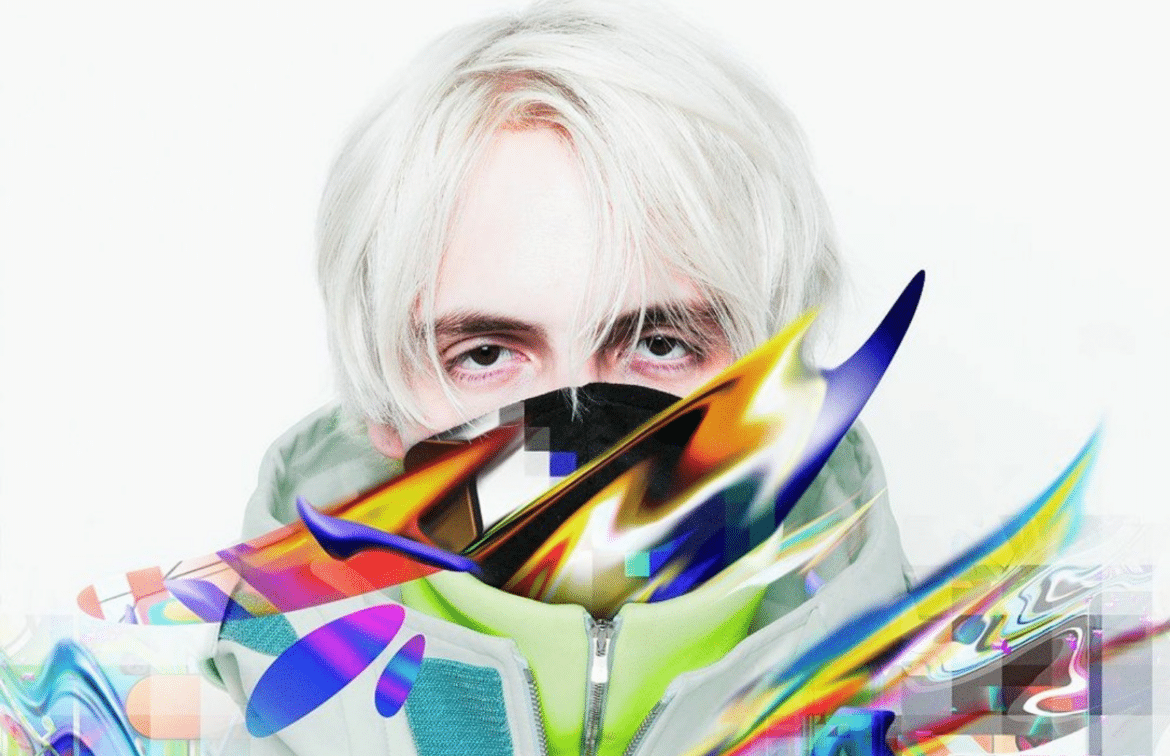

Tokyo-based electronic artist Moe Shop appeared at Anime Weekend Atlanta as a special guest, serving as the featured DJ for the convention’s Saturday night rave at the Georgia World Congress Center. The annual event ran from December 18–21, 2025, bringing together fans of anime, music, and pop culture from across the region.
Known for blending the floor-filling energy of French house with Japan’s neon-bright club scene, Moe Shop has carved out a distinctive space in the modern electronic music landscape. Their genre-spanning sound has resonated with a global audience, earning over 26 million annual plays on YouTube and more than 31 million streams on Spotify.
We had the pleasure of speaking with Moe Shop who, despite some jet lag and a busy schedule, kindly took time out of a packed convention weekend to speak with us early Saturday before their incredible rave set that evening to discuss performing at anime conventions, blending cultural influences, maintaining creative control, and how lived experience continues to shape their evolving sound.
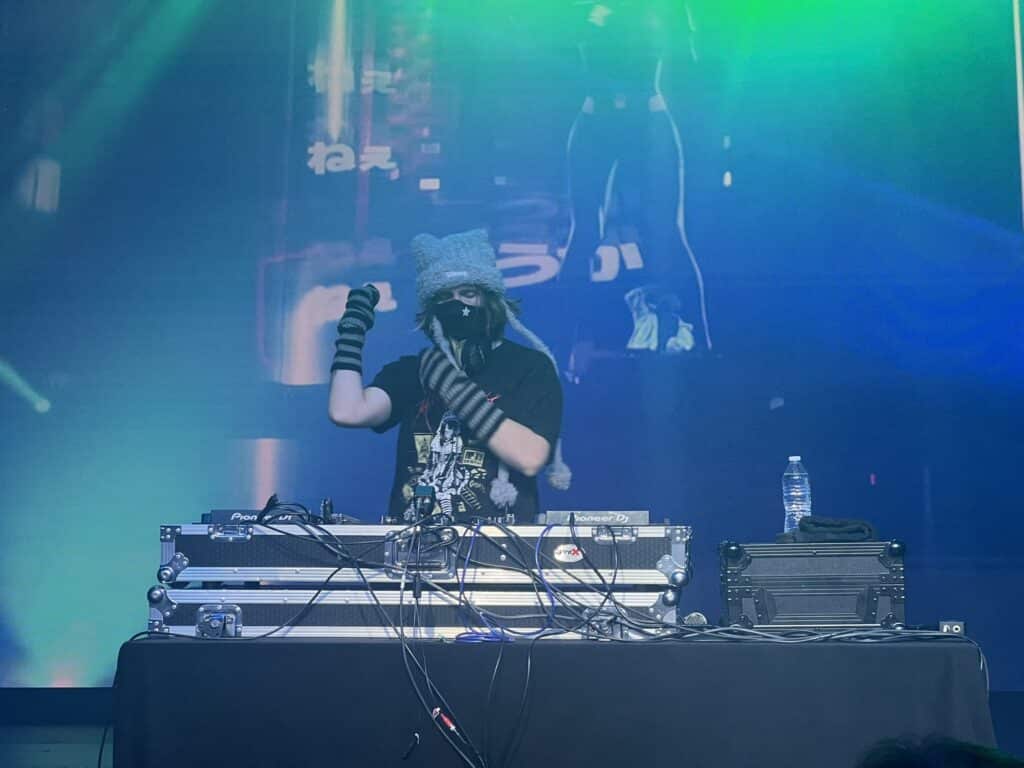
Moe Shop performing at Anime Weekend Atlanta 2025
LastLooks: I think it’s fair to say that your performance this weekend is one of the highlights—for us especially—so no pressure. (Laughs.)
Moe Shop: (Laughs) Yeah, no pressure.
LastLooks: Speaking of your performance at Anime Weekend Atlanta, how does preparing for an anime convention rave compare to a regular club set?
Moe Shop: With most DJ sets—perhaps in Tokyo or any club venue—you’re trying to fill the room. Most parties have some kind of theme or keyword. With conventions, there’s the whole context of an anime crowd; people have references. I try not to lean too much into that. I think I did in the past a bit, but not too much—like playing anime songs that are already out there.
With most raves I like to be part of, I feel like people are ready to party and have a good time. So I try to strike a balance between things you’ll likely know from internet culture and just some good, fat music—bass, electro, etc. I like to sneak in my own music, but also other things you might recognize. But the context of anime conventions makes it a little different in that aspect.
LastLooks: So you have a bit of a constraint, perhaps—but one that allows you to be creative?
Moe Shop: Yeah, and with a slot like today, it’s an hour, so it gives me plenty of time to really go everywhere. Start slow, then go up to many, many BPMs.
LastLooks: When you’re playing regular clubs, do you feel like a lot of your audience still comes from the anime community and culture—even when you’re removed from the “nerd world”?
Moe Shop: Yeah, I think so. It’s because the places on the internet where I come from—I’ve always been a nerd, and so has everybody in that scene. With that background, when I play in Tokyo people appreciate the music on its own, but a lot of my music—for example, projects like Gakuen—are very ongoing with anime culture.
There’s always this understanding that you’re here to play at a club, but you might pull something where one person is like, “Hey, that’s a mash-up of this song,” and they’re the only one who recognizes it.
LastLooks: Like a mash-up where maybe just one person knows it, but it makes their entire night.
Moe Shop: Yeah, to me that’s one of the most fun things to do. Sometimes I do it where, if it’s not for somebody, it’s for myself. But if there’s one person in there who’s like, “Ah, hell yeah,” maybe one guy who goes crazy—it’s like, yeah, you get it.
LastLooks: All for you.
Moe Shop: Right!
LastLooks: Gen Z and Gen Alpha are very into convergence—blending tastes and influences. You also bring together a lot of different worlds now, with your French background, living and performing in Japan, and drawing heavily from internet culture. How much of that comes together when you’re adapting your own music tastes and creating new work?
Moe Shop: Yeah, I think a lot of my influences—whether it’s making music, putting sets together, or even just in the studio—come straight from the experiences I have, whether I’m out playing shows or just listening to things.
In recent years especially, I’ve been more and more influenced by everyday life, whether it’s partying or just regular, everyday things.
I started Moe Shop when I was 17. Now I’m 27, still in my twenties, and I’ve gone through a lot of experiences with music projects, events, and stuff like this. So lately, I’ve been leaning more toward using everyday life as inspiration.
The project isn’t necessarily literal, but for my latest EP, EVO EVO, I just really wanted to do something very French—French electro, things I grew up with. So yeah, in recent years, it’s definitely been more and more inspired by life experiences, clubs, and everything I go through.
LastLooks: Who would be the most unexpected artist or genre that’s influenced you—something people wouldn’t immediately hear in your music?
Moe Shop: Like a lot of producers in my generation, you’ll hear Daft Punk and Justice right away. That goes without saying. Growing up, there was also a lot of funk music playing in my house.
All my influences are very scattered. I like gathering everything when I make a track. Lately, for example, I’ve been listening to a lot of hardstyle—things that are very high energy. I think I’ve also been rediscovering classics I missed before because I was focused on other stuff.
I’m pretty straightforward about it. What you hear in my music is a combination of all those artists. One artist that might not be surprising—but if you don’t know them, you’d immediately hear the influence—is TAK. He’s been very active in the Vocaloid scene lately. I’ve followed him since around 2015. He has this kind of house music with really distinctive textures that, to me, are peak house music. That sound palette—alongside Daft Punk—is a huge influence.
LastLooks: You’ve set up residence in Japan. Was there a genre or artist that really opened things up for you sonically once you got there?
Moe Shop: I think when I really connected with the music scene in Tokyo was when I was first booked there in 2016. I was already very online at the time, but it was mostly SoundCloud, Skype, and friends—I didn’t really know as much yet.
Being booked in 2016, I started learning a lot about Tokyo’s subculture. I was going to clubs like Lounge Neo, where there were heavy basslines, mashups, and these really nerdy club spaces. As I learned more about that side, I also started reconnecting with J-pop projects like Perfume, Capsule, and Kyary Pamyu Pamyu. I knew them before, but I hadn’t really connected the dots.
At some point, it just clicked. Before, everything felt separate, and then I realized how it all made sense together—and I loved all of it.
To this day, Yasutaka Nakata is one of my biggest influences. He produces so many projects I love, and realizing how much of what I liked traced back to his work was a huge moment of connecting the dots for me.
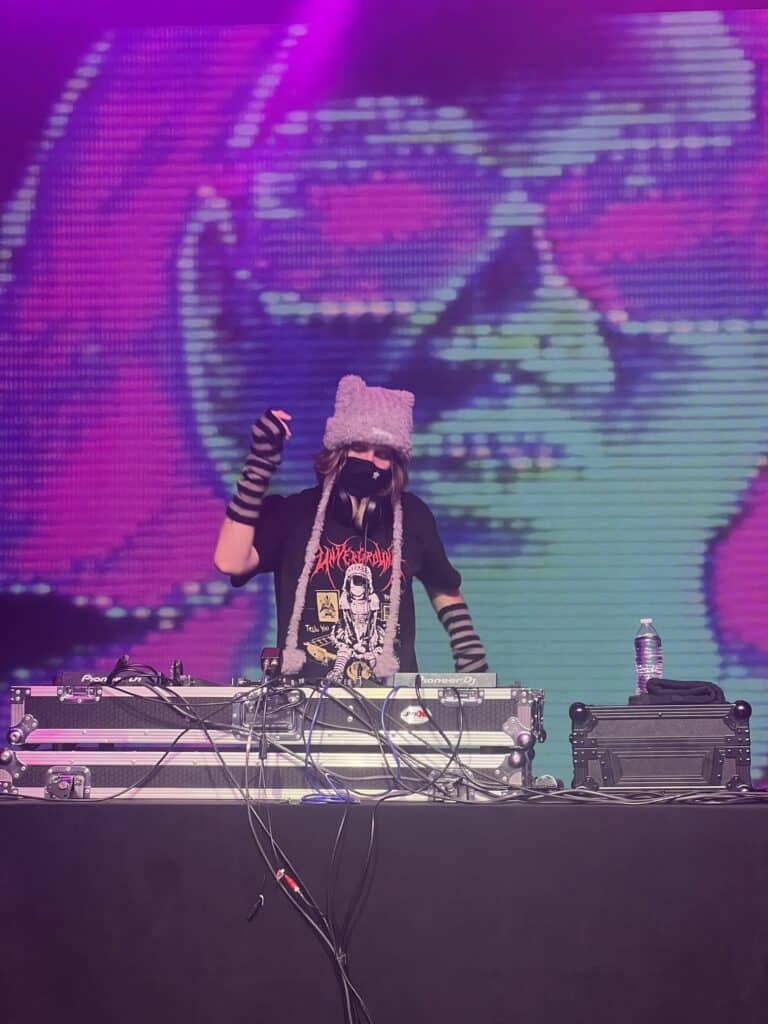
Moe Shop performing at Anime Weekend Atlanta 2025
LastLooks: Since we’re at an anime convention, I have to ask: if you could choose one anime project to be involved with, what would your dream collaboration be?
Moe Shop: I’ve got this one locked in—Panty & Stocking with Garterbelt. It’s something I’ve always been drawn to, both visually and sonically. There are a lot of anime I love, but Panty & Stocking feels like the perfect combination of the things I’m into, especially how music like this can be paired with something so bombastic and ridiculous.
LastLooks: It already plays so well with its influences, sometimes as tribute and sometimes with a wink.
Moe Shop: I love that too. It references things, but not as a private joke—it’s more like, “This is fun regardless.”
LastLooks: It also has a strong musical lineage already, especially with TeddyLoid.
Moe Shop: Right—TeddyLoid, all the classics. I remember talking with him years ago; we were actually meeting for the first time backstage at another show in Tokyo. We ended up nerding out for about an hour. He’s a huge French electro nerd too, so we were talking about samples, French house, and again just connecting the dots—like, “Oh yeah, all of this checks out.”
LastLooks: You release singles very consistently, but EPs feel more intentional. How do you approach building an EP?
Moe Shop: For a few years, I had a lot of momentum doing singles and one-off projects—commissions, collaborations, things like that. After releasing Moe Moe in 2018, I really wanted to make another EP, but it just didn’t happen for a long time. I think these things come together naturally. You can try as hard as you want, but nothing really works until the context feels right.
With EVO EVO, I knew exactly what I wanted to do. My placeholder name for almost a year was literally “French EP.” I didn’t have a clear idea of what the finished product would look like visually or sonically until right before release. I usually work track by track—I make things that feel consistent, but I don’t want to box myself in too much.
At the time, I was listening to Woman Worldwide by Justice, a lot of Jamaica, and just bathing in French music. Everything that came out naturally felt very French. Once the tracks were done, I started reaching out to artists I wanted to work with. I already had a connection with ono from Superorganism—we worked together, became friends, and spent time hanging out in the studio. I also knew I wanted to make another track with Jamie Paige, and that worked out really well too.
Once I have the tracks, I’m like, “Here’s the song, here’s where it fits in the EP.” I like keeping the concept abstract enough that people can interpret it however they want. I have my own internal interpretation, and I give collaborators some keywords or context, but I give them full freedom. Usually they come back with some of my favorite work because they really go all in on whatever they’re feeling at that moment.
That’s how it comes together—very free, very raw. Especially with Moe Moe, it was about keeping things raw, finishing it, and putting it out.
LastLooks: You’re also very involved visually—music videos, cover art, everything. How hands-on are you?
Moe Shop: Yeah, I’m 100% very involved—maybe to the point where “control freak” isn’t the wrong word. (Laughs) I always make sure everyone I work with is comfortable, but I really like being hands-on. Over the years, I’ve learned better ways to communicate feedback, mostly by giving very detailed notes. I also draw a lot—I’ve been drawing my whole life—and for me, music and visuals have always been connected.
When it comes to cover art, for example, for EVO EVO I worked with an artist named John Kafka, who’s amazing. I usually go through a lot of illustration compilation books—you can find so many of them in Tokyo, full of independent creators—and I’ll just flip through, find ones I like, and I’m like, “Hell yeah!”. Then I reach out. I usually give a rough idea, but I make it clear they have freedom, because if I’m working with someone like John Kafka, it’s because I want his style. After that, we go through feedback and notes together.
It’s the same with music videos, which I really started getting into this year. The first one for the EP, “Time Out,” was entirely directed and produced between me and a French group called losers!, who also handle all their visuals. It was basically three French people working together—I was in Tokyo, they were based in Paris. They helped find a warehouse, and we bought a bunch of junk off French eBay. A lot of it didn’t even work, like old CRTs, but we fixed things in post, stacked them together, and figured it out as we went. I drew about 20 stickers myself, they printed them, and we slapped them all over everything. We had a deadline, so once it was there, we just had to post it. The whole process was very raw, but that’s also what I love about it.
For another music video, I worked with a team that had made a fun video for my song “Love Taste” years ago, and I remember seeing it and being like, “this is incredible.” It really felt like a passion project—like they were just showing what they could do as a team in the studio. I loved that, so later I reached out and was like, “if I have a budget, are you interested in doing something again?”
It ended up being the same process all over again, just officially this time. Throughout the whole thing I was like, “here’s a drawing, here are many, many notes.”
So everything you see visually—cover art, music videos, all of it—I’m very involved. I even made the artwork for my Time Out single myself, mostly because with deadlines it’s like we don’t have time anymore, but I can be annoying with notes too so it was like I’ll do it myself. Sometimes it’s just easier to do it yourself. But for me, visuals and music are really 50–50. I’m involved in everything.
LastLooks: That makes sense—it really feels like a passion project, something you’re involved in at every step. You can tell there’s a clear concept behind everything, from the music to the visuals.
Moe Shop: Yeah, I’m really glad that comes through.
Stay tuned for more coverage of Anime Weekend Atlanta, including more exclusive interviews with special AWA guests, and photo galleries from Anime Weekend Atlanta 2025—only on LastLooks.org!