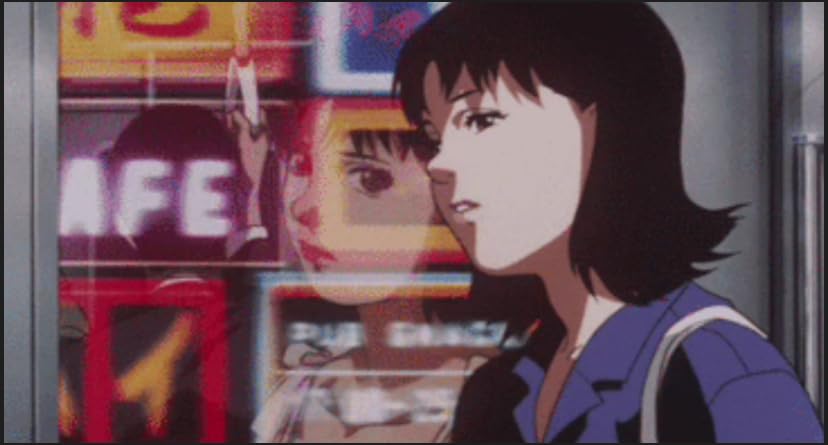

I first watched Perfect Blue twenty-two years ago in 2003, and it left a lasting impression on my fledgling mind that remains to this day. By then, Satoshi Kon’s directorial debut was only five years old. Now, 25 years after Perfect Blue’s initial release in Japan, the film has attained classic status, and as such it has been remastered in 4K and re-released for theatrical screenings across North America thanks to distributor GKIDS. I attended a recent screening with friends and fellow anime club members (never too old to be in a club), and once again the film blew my mind, as it continues to do so even after at least a half dozen viewings.
If you’re unfamiliar with the premise, the story, adapted from Perfect Blue: Complete Metamorphosis by Yoshikazu Takeuchi, follows Mima Kirigoe, a member of the fictional J-pop trio Cham!, a girl group with a respectable fan base but a career trajectory that seems destined to hover just outside the charts and the culture’s collective consciousness. Mima, in a move partly of her own choosing but also guided by her agents—and perhaps by the times, as idol groups are said to be “done” (so claim several characters in the film)—decides to leave the group to become an actress and shed her idol image. Much to the dismay of her devoted fans, Mima “graduates” from Cham! and enters the murky world of acting, fraught with exploitation and manipulation. As she’s pushed forward by agents, industry insiders, and her own muddled ambitions, Mima begins to lose her grip on reality, while we, the audience, are along for the ride, equally unsure of what’s real and what’s imagined.
Though the film has stayed the same these past twenty-five years, so much has changed for me and my viewing experience. After all, I was 18 during my first viewing and was immediately shocked by the film’s sex and violence. This film made me realize that anime wasn’t just Dragon Ball Z or Princess Mononoke, but could serve as a prism for exploring the modern world, filtered through the dreamlike logic of a true auteur. (There’s a reason Kon is often cited as an influence on Darren Aronofsky.) Now, as a devoted fan of Kon’s works and a completionist, I appreciate so much more. Yes, I delight in Kon’s signature surrealist touches; yet with titles such as Tokyo Godfathers, I’ve come to see that he never loses sight of the humanity of his characters. Mima, as confused and fragmented as she becomes, always feels real. We may not fully understand her, but we still want to root for her, just as her Cham! fans once did.
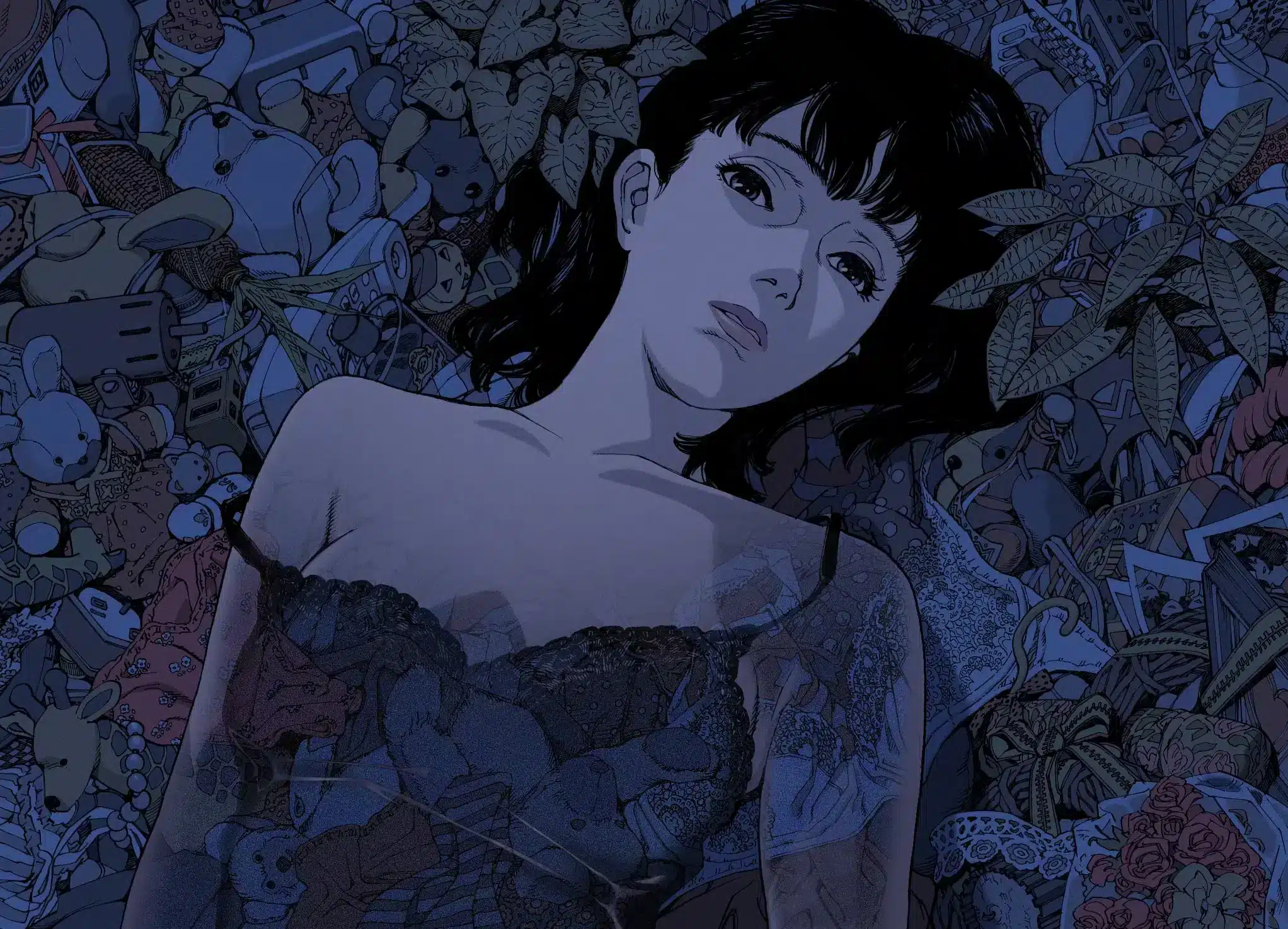
Perfect Blue by Satoshi Kon (Source: GKIDS)
Having grown to appreciate Kon’s humanity in his characters, I can also better see how he interrogates the darker mechanics of celebrity culture. Through the interplay of reality, delusion, and the TV drama within a drama, he positions us as both viewers and voyeurs. This is best demonstrated early in Mima’s acting career when her agent pushes her to perform in a rape scene—a dramatic departure from the virginal image expected of idols. Mima agrees, despite the protests of her more protective manager, Rumi. Kon presents the scene as both horrific and oddly sanitized, even including the male actor’s apology mid-scene. It mirrors what viewers of Mima’s fictional show might find “safe” to watch, knowing the viewers of the drama (and we as well) know these are simply actors in a scene.
Kon then takes this a step further as Mima is shown participating in a gravure shoot—arguably even more titillating, yet also seedier, as we’re told (though Mima is not) that the photographer is known for pushing boundaries. We’re seemingly shown two versions of the shoot, both resulting in the photos being taken, but one with Mima more actively protesting. In this way, Kon again ramps up our voyeurism, putting Mima’s body on display for we the audience while also suggesting, through our knowledge of the scene, that we should interrogate our feelings as viewers. If this nuance is missed, the trap is fully set to go off in the final third as Mima is assaulted for real by Me-Mania. Kon implicates not only the fans in Mima’s world, but also the viewers of his own film, as he mirrors the rape scene in the drama—a scene between actors—with this horrendous assault by a “fan”. By offering the suggestion of titillation earlier in the film in presumed “protective” environments, Kon gradually reveals our complicity in Mima’s exploitation.
Of course, in reality the idol industry itself is no purer than the world of actors and actresses. (MeToo alone provides a lot to reflect on in this film, as it has our culture.) In the world of idols, the key players, often male and powerful, shape and consume the personas of young women to match male fantasies. Much like the late 1990s era of Britney Spears and other ingénues, these idols are pressured to be both chaste and desirable. Me-Mania, the film’s distorted male fan, becomes a stand-in for this parasocial possessiveness. He tries to “protect” Mima’s purity by destroying her adult images, freezing her in time within a shrine-like apartment. His obsessive control mirrors that of the agents and producers who exploit her. Though Kon portrays Me-Mania as grotesque—almost cartoonishly so—the critique would be sharper if he weren’t so physically monstrous, as psychosis and fandom obsession often hide behind much more ordinary faces.
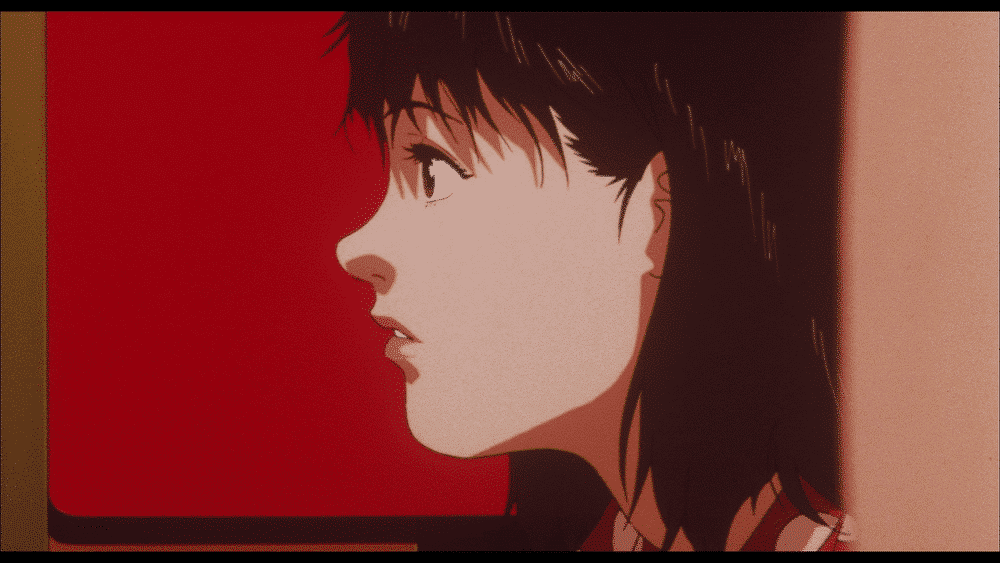
Perfect Blue by Satoshi Kon (Source: GKIDS)
Yet the film ultimately reveals that the true source of the violence surrounding Mima lies with Rumi, her mentor and former idol, who through dissociation becomes the “real” Mima in her mind. Rumi directs Me-Mania’s actions and enacts murders to “protect” the image of Mima the idol. It’s a tragic reflection of her own faded career and the industry’s cruelty toward women past their prime. When I caught Rumi’s early admission that she herself was once an idol, it recontextualized everything—her motives aren’t just envy, but the longing of someone who was chewed up and discarded by the same machinery. Her descent mirrors Mima’s own fragility, both women trapped by the roles they once played and the images others built for them.
Upon this last viewing, I found myself fixated on the ending—not Rumi’s diagnosis, which feels too neat, but Mima’s sudden stability and stardom. As hospital workers gossip about her fame, one insists, “There’s no way that’s Mima.” Her confident reply, “I’m the real thing,” seems reassuring, but it also echoes with irony. How much of what we’ve seen is truly her? How much has she absorbed from the fiction, the trauma, the spectacle of being watched? Perhaps she has survived by becoming what the world demanded—a perfected version of herself.