
Introduction: 25 Years Later
Battle Royale, the novel written by journalist and author Koushun Takami about a dystopian Asian country, the Republic of Greater East Asia, where a totalitarian regime passed an act forcing one class to fight each other in the titular Battle Royale, was written in 1996 but did not hit shelves until 1999, whereupon it became a surprise success. Hardly a year went by before director Kinji Fukasaku, a director known for his on-screen portrayals of gore and violence, released his adaptation of the film, taken from a screenplay by his son Kenta Fukasaku. Despite the controversial nature of the film, which puts stark violence between children on the big screen, the novel and film alike have become critically and culturally celebrated, leaving footprints on works such as Kill Bill (directly), The Hunger Games (allegedly indirectly), and others. Now, upon its 25th anniversary, it has returned to theaters in a 4K remastered version of the original theatrical cut, alongside an opening interview with Kenta Fukasaku about the making of the film.
Interview with Kenta Fukasaku
For those who have yet to see Battle Royale, my warning, aside from being prepared for violence, is that this interview, though welcome, contains many spoilers. The visuals cut to key scenes in the film, including one clearly from the end, and even the questions themselves, as Kenta speaks to various characters’ motivations, reveal major plot points. As a fan of this film who has seen both this and the Director’s Cut many times, I appreciated this additional insight. Kenta helped contextualize his father’s work for me, who, despite being known in the West largely for this film, his last, has a deep history of filmmaking where violence as a core theme ran through his works. Kenta also spoke to the Japan in which this film was made, saying perhaps not much has changed now; indeed, Japan’s so-called “Lost Decade” has become plural, covering many more years beyond the 1990s. In particular, he noted that the economic depression in Japan, alongside wayward youth and uncertain adults struggling to take care of themselves and their families, came together in many ways that the original novel spoke to in metaphor, but that Kenta’s screenplay and his father’s film addressed more directly. I greatly appreciated all of this; however, I would have preferred this interview to begin after the trailers and not prior.
The Film Begins
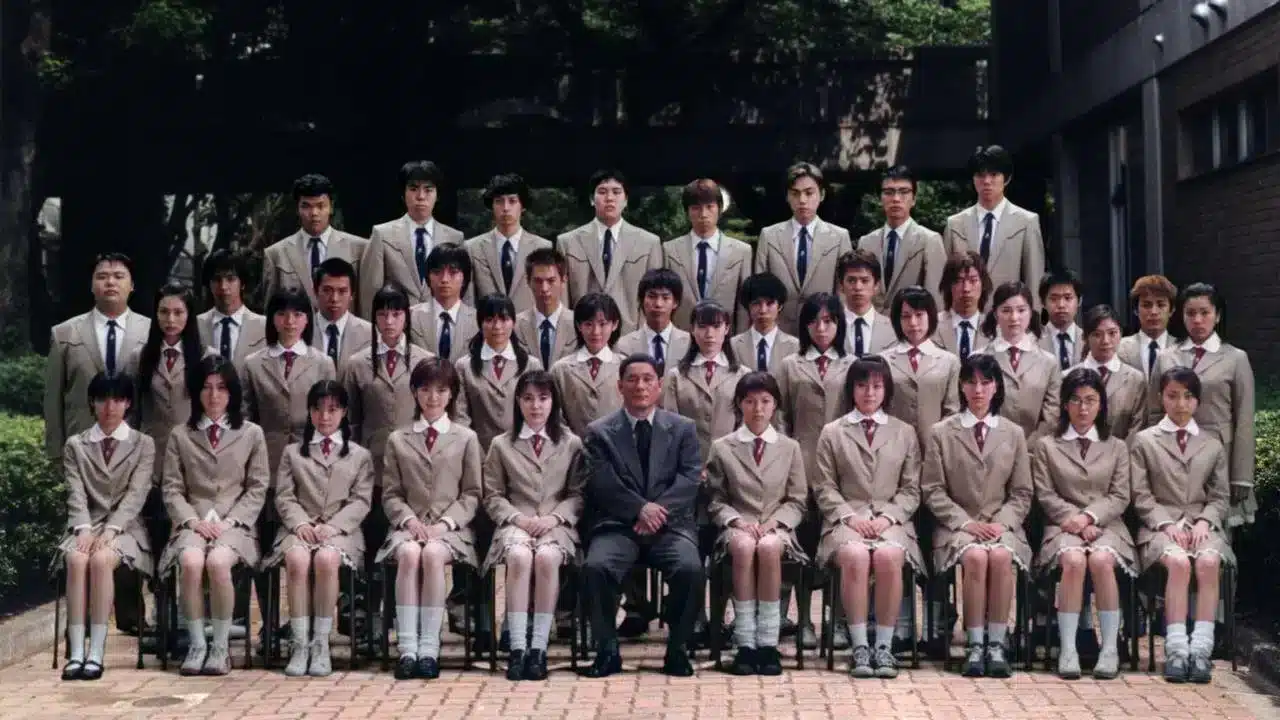
Class photo of students in Battle Royale (2000)
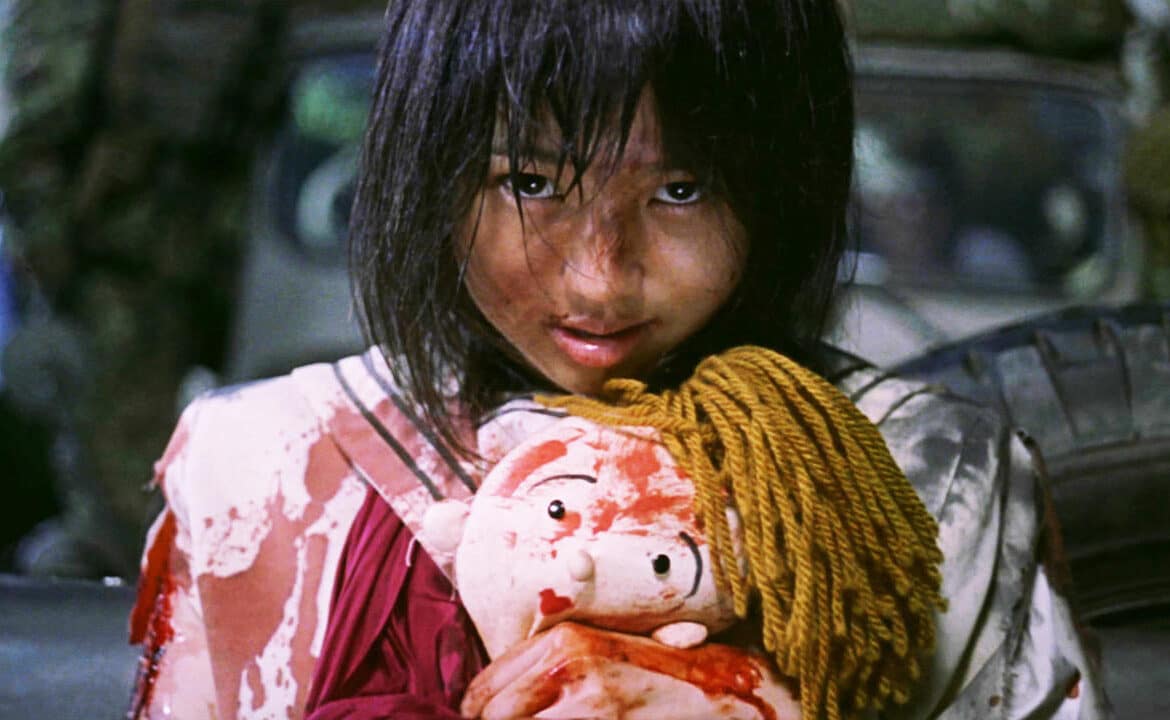
As for the film itself, it begins with a media spectacle in which a journalist tries to locate the last survivor of the Battle Royale Act. We hear more than we see at first, as she discovers the survivor is a girl, and then we are brought in close on her bloody face, who breaks out into a mysterious, perhaps malicious, smile. Shortly thereafter, we transition to a ninth-grade class on a field trip. It is a raucous scene, as one might expect from youth of that age, but we see small moments of friendship, camaraderie, and cliques that define later interactions. Increasingly, we the audience and some of the more observant characters notice the military lining the road, and though no one questions it, Shuya Nanahara, one of our lead protagonists, wakes up in a haze, sees his classmates completely asleep, and is quickly knocked out by a mysterious woman in a gas mask. Upon waking in a strange classroom, the students, surrounded by a military presence, are greeted by their old seventh-grade teacher, Kitano, himself a victim of a stabbing by one of the children. He introduces them to the Battle Royale Act and quickly explains the murderous game they must play while showing how real the violence is.
Performances and Characters
Now, 25 years on, many elements of this film play as strongly as they ever did. The commitment of Takeshi Kitano, a legendary actor even before this film, is an absolute grounding force, even as his antics increasingly seem nonsensical. Likewise, the horrors of the film, though occasionally broken up by hammy acting and quirky deaths, still have the impact that was intended. Tatsuya Fujiwara, who plays Nanahara, is scene-stealing, but considering the circumstances, appropriate. Aki Maeda, who plays Noriko Nakagawa and is enamored with Nanahara, also roots the film in reality in ways that I perhaps underappreciated before; her role requires subtlety, which she pulls off marvelously.
What perhaps is less strong is the silliness of certain moments. Some deaths are especially quirky, such as sudden neck twists to indicate deaths. Also, though I appreciate it now, I think tonally some may still be puzzled by Kitano’s character near the end, especially the cell phone call. It is truly one of the more surreal moments of the film, but one I have come to like, though it may pull some viewers out of the story.
The Cuts: Theatrical vs. Director’s
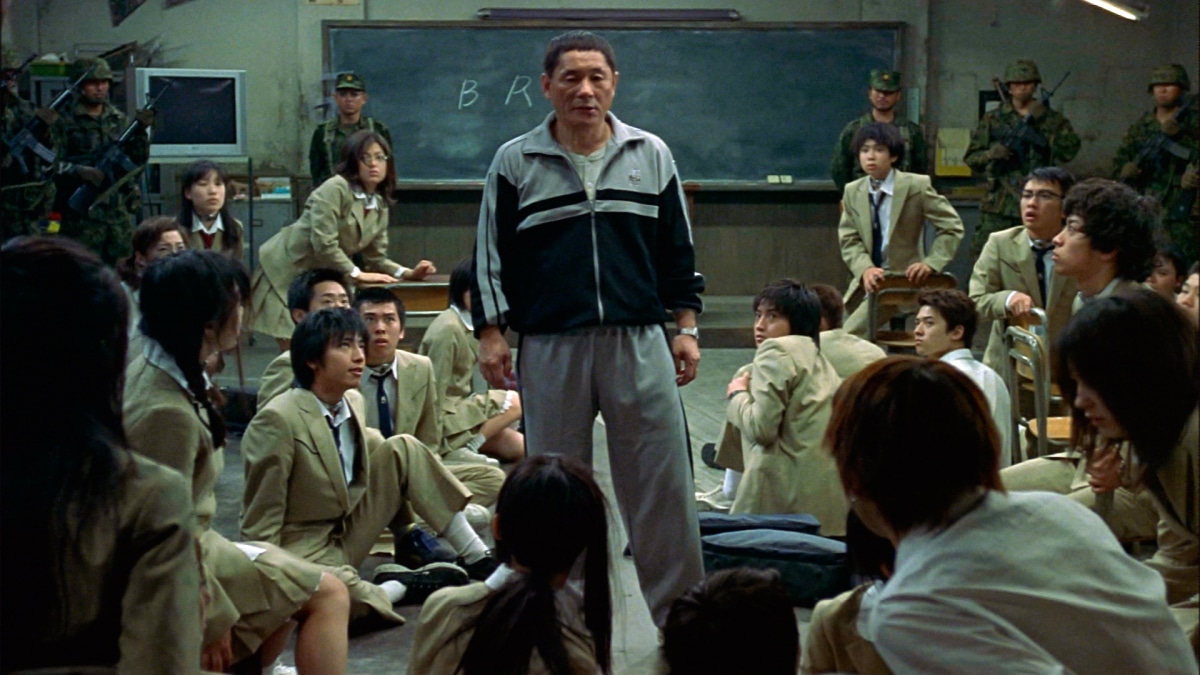
Beat Takeshi and students in Battle Royale (2000)
My only other note upon seeing this particular version in theaters is that it is indeed the theatrical cut and not the Director’s Cut, which I have seen more often and in fact prefer. I understand why cuts were made, as they make the film leaner, and some sequences, particularly on the basketball court, may feel too long for casual viewers. However, they also add importance to the relationships in the film. It is perhaps the one time all the characters seem at least happy, and that juxtaposition of horror and happiness makes the story all the more harrowing. The Director’s Cut also fleshes out more character backstory, including Mitsuko Sōma, played so well by Kō Shibasaki. One scene, briefly shown in the intro interview, changes much of what we know about the character. I would ultimately suggest anyone who appreciates this film seek out the Director’s Cut, but even in its truncated form, it remains incredible.
Why It Still Resonates
What is perhaps most incredible is that 25 years on, the film feels little like a remnant of the past. It continues to speak to increasingly totalitarian, militarist societies, the rebelliousness of youth, the fecklessness of powerless adults, and the violence that often lies at the center of it all. In his interview, Kenta Fukasaku suggested that his father, puzzled by Noriko’s non-violence, saw violence as a necessity at times. We live in a world where some leaders still believe this to be true, especially as they try to hold on to power. At the same time, many citizens, beset by external forces and the failures of their own governments, like Nanahara and Noriko, must figure out how to survive and stand up for themselves, no matter the circumstances they are given.